The XI edition of GNUHealthCon will take place in Gran Canaria, Spain, this December 18th, and you are invited!
Celebrating 20 years of Freedom and Equity in Healthcare
This edition is special for us because we will be celebrating the 20th anniversary of the first GNU Solidario mission that took place in Santiago del Estero, Argentina in October 2006. That remote rural school, the teachers, the children and their families generated a profound inspirational impact on me, so deep that since then I have dedicated most of my life to the field Social Medicine. GNU Health is both a result of that experience, and the main channel to deliver freedom and dignity around the globe.
In this edition, besides the technical and social talks, we will have the space to commemorate these 20 years. During these two decades we have gone through many things. We have many happy stories to share, but we also have sad ones, that made us learn and be more resilient. Stories of people from countries around the world that have conformed this wonderful community around GNU Solidario. Stories and experiences that have made GNU Health the leading Free/Libre Health and Hospital Information System.
I want to personally invite all of you who has been part of this beautiful journey: The GNU community; hospitals and health institutions around the world that use GNU Health; sister projects (Tryton, Orthanc,..); national and regional governments that have adopted GNU Health; sponsors; the open science and academic communities; developers and core team members… you are all part of the success of the project and we have to celebrate this edition together.
Pre-conference party
GHCON2026 will be on Friday, December 18th in Gran Canaria. The night before we will have the pre-conference party. Most probably, the event will be in a hotel in the mountains, and the idea is to arrive to the hotel on Thursday 17th. We will update in our official Mastodon account. (look for #GHCon2026 hashtag)
The 10th edition of the GNU Health Conference – GHCon2025 – will be this December 20th and it will be broadcasted from Las Palmas de Gran Canaria.
In the context of GHCon, it will take place the XVIII International Workshop on eHealth in Emerging Economies (IWEEE). IWEEE is about Social Medicine and addressing the reality of the underprivileged around the world. We will be sharing experiences with those working in field of Social Medicine.
Presentation submissions and guidelines
The deadline for submitting your presentation is Sunday, December 7th, and the presentation in PDF needs to be turned over by Monday December 15th.
This year GHCon will be online, and the presentations will be delivered via Jitsi. Each presentation has a 30 minute slot, plus and additional 10 minutes for questions. We count on your cooperation so we can have a smooth program and transition between speakers.
We will be publishing the program by Wednesday, December 10th.
GNU Health en español
Given the vast amount of implementations and the large Spanish community of GNU Health, this year we’ll divide the talks in two sections based on the language of the presentations and talks:
Morning session : English
Afternoon session: Spanish
We believe this model enriches GHCon and provides an opportunity for those who want to share their experiences in Spanish. Of course, everyone is welcome to join both sessions. The afternoon session is also good in terms of timezone for our friends in Latin America.
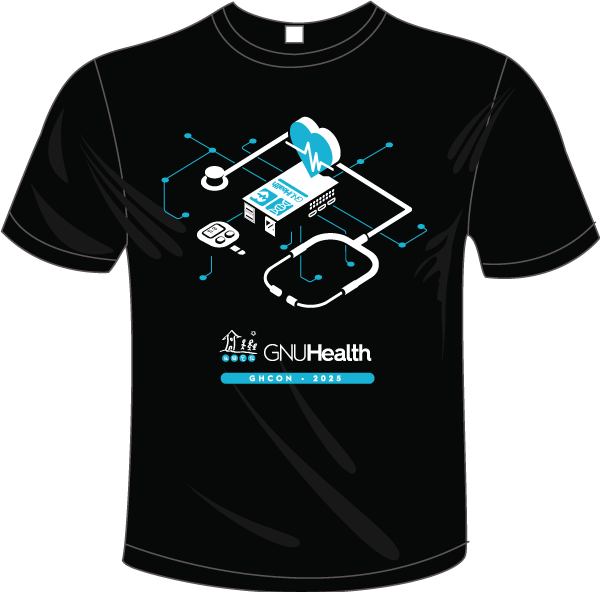
If you want to get the coolest t-shirt, and, most importantly, support our cause for freedom, equity and privacy in healthcare, you can buy the GHCon2025 from the GNU Solidario online store.
Happy Hacking!
We are excited to deliver this new edition of annual GNU Health conference, the perfect moment of the year to get together and keep on building the community around the world.
Looking forward to seeing you at GHCon2025, the Free Software and Social Medicine conference!
We are very happy to announce that the upcoming version of GNU Health Hospital Information System has entered feature-complete alpha stage. This upcoming version of GNU Health HIS 5.0 supposes over a year of work and is the largest release in terms of functionality and refactoring.
GNU Health HIS 5.0 is expected to be released by the end of June.
This new release comes after over a year of development to deliver state-of-the-art libre technology and user experience. In a nutshell:
Tryton 7.0 LTS support
New functionality for patient procedures and medical interventions
Improved reporting and analytics
Enhanced the Laboratory Information System (GNU LIMS – Occhiolino)
New features on patient obstetric history and pregnancy related evaluations
Improved ergonomics and views on demographics and patient related information.
Improved medical genetics and family history taking. Update to the latest genes, proteins and natural variants datasets from UniProt and HUGO
Enhanced socoeconomic and family functionalty assessment
Extensively revised Medical Imaging, DICOM worklists and Orthanc packages
Reorganize nursing and ambulatory care packages
Enhanced patient body composition and anthropometrics
Enhanced “Focus on” patient section, including automated settings and mental health
New insurance and billing features for medical interventions and insurance plans.
Improved patient safety and allergic conditions checks and prescription writing
On the technical side we have worked on:
Migration to Python Poetry and pyproject.toml from setuptools
Increased modularity and minimize dependencies among packages
Simplified installation and administration (Virtual machine images, pip, ansible)
Improved stability using virtual environment in the installation
Over 30 localization and language teams at Codeberg.
At this point, our focus in on testing, translation, packaging and documentation. In the coming days we’ll migrate our community server so we can all test the upcoming version.
For those of you on GNU Health 4.4, please start thinking on the migration project to GH HIS 5.0. This new version is a major leap that delivers many benefits, so we highly encourage you to upgrade. As always, the migration methods and tools are included.
We’d like to invite you to translate GNU Health at Codeberg weblate translation instance and to report any issues you may find during this period.
GNU Health is a Libre, community driven project from GNU Solidario, a non-profit humanitarian organization focused on Social Medicine. Our project has been adopted by public and private health institutions and laboratories, multilateral organizations and national public health systems around the world.
The GNU Health project provides the tools for individuals, health professionals, institutions and governments to proactively assess and improve the underlying determinants of health, from the socioeconomic agents to the molecular basis of disease. From primary health care to precision medicine.
The following are the main components that make up the GNU Health ecosystem:
Hospital Management (HMIS)
Social Medicine and Public Health
Laboratory Management (Occhiolino)
Personal Health Record (MyGNUHealth)
Bioinformatics and Medical Genetics
Thalamus and Federated health networks
GNU Health embedded on Single Board devices
GNU Health is a GNU (www.gnu.org) official package, awarded with the Free Software Foundation award of Social benefit. GNU Health has been declared a Digital Public Good ,adopted by many hospitals, governments and multilateral organizations around the globe.
We’re excited to announce the IX International GNU Health Conference, that will take place in beautiful Sicily, Italy, at the University of Palermo this December 15th.
Mount Etna rising over suburbs of Catania, Sicily (Wikimedia)
The GNU Health Conference (GHCon) is the annual conference that brings together enthusiasts and developers of GNU Health, the Libre digital health ecosystem. The conference will have thematic sessions, lightning talks and implementation cases to get to know the GNU Health and other Free/Libre software communities from around the world.
We will show the upcoming features of the Health and Hospital Information System, standards, security, privacy, the GNU Health Federation and MyGNUHealth (the Personal Health Record).
GHCon2024 – The IX International GNU Health Conference
The XVII International Workshop on eHealth in Emerging Economies (IWEEE) is about Social Medicine and addressing the reality of the underprivileged around the world. There will be workshops to debate, and share experiences from humanitarian organizations and from those working in field of Social Medicine.
In the evening we will announce and honor the winners of the GNU Health Social Medicine awards.
We are counting on you to get the most out of the conference. Most importantly, we want you to have fun, feel at home, and enjoy being part of the GNU Health community.
It’s no news. They’re stealing the Internet from us and we must do something about it. What it used to be a fun, collaborative hacking space is now ruled by corporations and narcissistic billionaires. Proprietary centralized social networks have become a space for hate, discrimination and propaganda. The messages that you see are those that they want you to see. Your data is no longer yours. They have become a massive thought control machine. You read what they want you to read and, in the end, you will end up writing and doing what they want you to write and to do. It’s a matter of time and money, and they have both.
These corporate-driven social networks are deceiving. They make us fall into false assumptions in a distorted reality. This delusion hits both individuals and organizations. For instance, in GNU Solidario and GNU Health, we fight for Social Medicine and for the rights of human and non-human animals. When we want to share an event, to make a fundraising campaign or to denounce human or animal rights violations we want the message to reach out as many people as possible. We could think, why not share it with our followers on Twitter / X? Experience has it, corporate social networks have not really made a difference in the outcomes. They will promote or “shadow ban” the message depending on who wrote it. You can guess the results for those who fight against neoliberal capitalism.
“The many branches of the Fediverse” (credits: Axbom)
Social pressure exists, and is not trivial to overcome. Many fear that leaving proprietary centralized social networks that have been using for years will result in losing the status and contacts they’ve built throughout the years. Again, it’s not really a big deal. And we have great news, there are decentralized, community-driven alternatives! Some of those alternatives are Mastodon, Friendica or Diaspora. Not only social networks, today there is an free software alternative to pretty much any proprietary solution (search engines, scientific programs, multimedia, office suites, databases, games…)
The GNU head, symbol of the GNU project
There is a correlation between Free Software, freedom and privacy. The more Free Software, the more freedom and privacy you enjoy. The contrary also applies: Proprietary software is inversely proportional to our freedom, both at individual and collective level. There is no transparency, no privacy, no control, no rights in proprietary applications, networks or clouds.
In the last decades, the tech giants have been busy in a campaign to dismantle the Free Software philosophy and community. The “open source” euphemism is one of them. Richard Stallman (creator of the GNU project and the Free Software Foundation) has been warning us about the dangers of “Open Source”. Free societies are built with free software, not with open source. I know some members in the free software community use both terms interchangeably, but I am convinced using the “Free Software” terms not only delivers software, but also freedom to our society.
Internet is no longer fun or empathetic. It has become a hostile and toxic environment, the medium for corporations and elites that increase concentration of power, social gradient and create very unjust societies. They use our data to control individuals and governments. We certainly don’t want to be part of that.
It is our moral duty to bring back spirit of solidarity that RMS delivered in the late 80’s, and that made possible the GNU movement, the best operating systems, programming languages, web servers and database engines for everyone. The GNU project was the inspiration for projects like GNU Health, helping millions around the globe, delivering freedom and equity in healthcare.
In the end, it is up to us to embrace federated, community driven social networks and free software applications. Millions of individuals, activists, free software projects, NGOs and even the European Union have already joined the Fediverse and Mastodon. It only takes an initial push to break the social pressure to set ourselves and our societies free.
Collage with some members of the GNU Health community around the world
Citing our friends from GNUnet: “You broke the Internet… we’ll build a GNU one”.
Sea-Eye Search and Rescue missions in the Mediterranean and how GNU Health can help them
The title of this article, “Migrar, migrant, migràrem“, comes from a beautiful poem written by Laia Porcar[1], that inspired the strikingly profound painting by Sara Belles [2] “Jo per tu, fill meu“. The artists reflect the migrants ordeal to provide a better life to their children and families, even at the cost of losing their own lives.
GNU Health[3] is a Social project with some technology behind and the mission at Sea-Eye is one of the best examples. After all, GNU Solidario[4] is a NGO that focuses in the advancement of Social Medicine.
We live a world of injustice. Concentration of power, social gradient and poverty rates keep on the rise. Artificial intelligence is on the hands of mega private corporations, targeting our privacy and feeding the macabre business of war. The fight for scarce natural resources such as lithium or coltan creates coups in impoverished countries. Nature and non-human animals are used and abused as mere commodities. Our world turns a blind eye to the systematic crushing and eradication of civilian population by powerful armies. As a result, we live in a world where migration is not a choice, but the only way out for millions of human beings, even at the risk of becoming anonymous victims in the Atlantic ocean or Mediterranean sea mass graveyards.
“Jo per tu, fill meu”, by Sara Belles
But there is hope. The Sea-Eye mission is the end result of a network of solidarity, cooperation and empathy. The Free Software movement started by Richard Stallman[5]; Julian Sassenscheidt message in Mastodon and his presentation at GNU Health Con 2023[6] ; The work of our representative in Germany, Gerald Wiese; the Chaos Computer Club[7]; the team from L’Aurora[8] providing logistic support to the Search and Rescue vessels; the phenomenal Sea-Eye family who made me feel at home: The cook, crew on deck, the logistics and medical team who stood stoically intensive hours of GNU Health training. Of course, Selene, the heart of GNU Solidario and the one that looks after the human and non-human family members while I’m away.
You will hardly see these people in the news, because most corporate-backed media neglect them and their organizations. Unlike some billionaire “philanthropists” that take the media spotlight, these anonymous heroes stand on the right side of history, making a difference on the present and future of those who need it most, with very limited resources.
Collage of several pictures during my stay at the Sea-eye
We’re very happy and proud to see that GNU Health can be of help to Sea-Eye in tasks such as guests registration, health evaluations, reporting, statistics and stock management. This is just the beginning and we will be optimizing and adding functionality on successive missions. That said, GNU Health will always play a secondary role compared to picking up somebody from the water and giving them a welcoming hug. Again, we’re a social project with a bit of technology behind.
Drawings made by the children rescued at the Sea-eye
I’d like to finish with a reflection on the picture I took to some of the drawings done by children during their stay at the Sea-Eye. The drawings exist because the Sea-eye crew rescued those kids. Otherwise, their corpses would be at the bottom of the Mediterranean sea, along with thousands who tragically perished trying to find dignity in this world. Thank you, Sea-eye. You are priceless.
A final note: shame on those countries and governments that detain and punish Search and Rescue vessels. Saving lives is not a crime.
Love, freedom and happy hacking
You can obtain Sara Belles painting and Laia Porcar poem from L’Aurora solidarity shop[8]
Hospital Escuela de Salud Mental chooses GNUHealth to improve their resources, clinical records and patient management
The World Health Organization defines health as a state of complete physical, mental and social well-being and not merely the absence of disease or infirmity.
Unfortunately, this definition is far from being a reality in our societies. Instead of embracing the system of health, we live in the system of disease, ruled by a reactive, reductionist and unsustainable model of healthcare. The beautiful noble art and science of medicine is ill. Financial institutions and giant technological corporations are removing the human factor from medicine, transforming people and patients into clients. They are reducing the non-negotiable human right to healthcare to a privilege of a few.
Coming back to the formal definition of health, in the current system of disease very little is taken into account from the social and mental well-being . Today, many people with mental health conditions not only have to deal with the physiopathological aspects of the disorder, but also with the stigma, exclusion and invisibilization from the society.
But there is hope. Medicine is a social science, and GNUHealth is a social project with some technology behind. That feeling of optimism and hope has been reinforced in last week trip to Argentina and their people. In the end, medicine is about people interacting and taking care of people. Is about people before patients. I know them well, because I did my medical career in Argentina.
Group picture with health professionals from HESM, UNER, Government officials and GNU Solidario at the entrance of the leading Public Mental Health Hospital in Entre Ríos, Argentina
The Mental Health Hospital has chosen GNUHealth to improve the management of the institution resources, as well as to provide the best medical care for their community, both in outpatient and inpatient settings. Being able to properly identify every person who needs attention, and knowing the socio-sanitary, medical and clinical history in real time will make a big difference in the care of the individual.
The implementation of GNUHealth in this health institution will be lead by Prof. Dr. Fernando Sassetti and the department of public health studies of the University of Entre Ríos in the context of the GNU Health Alliance of Academic and Research Institutions agreement signed with GNU Solidario.
Health is an equilibrium of the inseparable and interconnected physical, social, mental and spiritual domains. Medicine is about taking into consideration and maintaining this body-mind-spirit-environment balance. This holistic approach to medicine is encoded in the genome of every nurse, psychologist, social worker and doctor from the Mental Health Hospital and the Primary care centers I got to know during these years in Entre Ríos, Argentina.
Fundación Jérôme Lejeune Argentina adopts GNU Health for the research and management of Trisomy 21 and other intellectual disabilities of genetic origin.
We start 2023 with exciting news for the medical and scientific community!
GNU Health has been adopted by Fundación Jérôme Lejeune, a leading organization in the research and management of trisomy 21 (Down Syndrome) and other intellectual disabilities of genetic origin.
Jérôme Lejeune foundation has its headquarters in France, with offices in Argentina, the United States and Spain.
On December 2022, the faculty of engineering from the University of Entre Rios, represented by the dean Diego Campana and the head of the school of Public Health, Fernando Sassetti, formalized the agreement with the director of the Jêrome Lejeune foundation in Argentina, Luz Morano.
The same month, I met in Madrid with the medical director and IT team of Fundación Jérôme Lejeune Spain.
Luz Morano declared “[GNU Health] goes beyond the Foundation, providing the health professionals the specific features to manage a patient with trisomy 21. We are putting a project in the hands of humanity“
[GNU Health] goes beyond the Foundation, providing the health professionals the specific features to manage a patient with trisomy 21. We are putting a project in the hands of humanity
Luz Morano, director of Fundación Jérome Lejeune, Argentina
Morano also stated: “GNU Health will pave the road for the medical management, and let us focus on our two other missions: Research and the defense of patient rights“
GNU Health counts with specific modules for genomics and bioinformatics
The agreement is in the context of the GNU Health Alliance of Academic and Research Institutions that UNER has with GNU Solidario. In this sense, Fernando Sassetti explained “It provides tools for an integrative approach of those people with certain pathologies that due to the reduced number are not managed in the best way. This will benefit the organizations and health professionals, that today lack the means to do so in the best way and timely manner. It benefits the patients, in their right to have an integral health record.”
Research and Open Science
The adoption of GNUHealth by the Jérôme Lejeune Foundation opens new exciting avenues for the scientific community. In addition to the clinical management and medical history, GNU Health will enable scientists to dive into the fields of genomics, epigenetics and exposomics, gathering and processing information from multiple contexts and subjects, thanks to the distributed nature of the GNU Health Federation.
The GNU Health HMIS counts many packages and features, some of them of special interest for this project. In addition to the specific customizations for the foundation, the packages already present in GNUHealth, such as obstetrics, pediatrics, genomics, socioeconomics or lifestyle will provide a holistic approach to the person with trisomy 21 and other related conditions.
All of this will be done using exclusively Free/Libre software and open science.
People before Patients
Trisomy 21 poses challenges for the individual, their family, health professionals and the society. The scientific community needs to push the research to shed light on the etiology, physiopathology and associated clinical manifestations, such as heart defects, blood disorders or Alzheimer’s.
Most importantly, as part of the scientific community, we must put a stop to the discrimination and stigmatization. We must tear down the barriers and walls built on our societies that prevent the inclusion of individuals with trisomy 21.
As part of this effort, GNU Health provides the WHO International Classification on Functioning, disability and health (ICF). In other words, is not just the health condition or disorder we may have, but how the environmental factors and barriers influence the normal functioning and integration as individuals in the society. Many times, those physical, artificial barriers present in our daily lives are way more pernicious than the condition itself.
The strong focus of GNU Health in Social Medicine, and the way we perceive medicine as a social science will help improving the life of the person living with trisomy 21, and contribute to the much needed healing process in our societies. We need to work on the molecular basis of the health conditions, but little can be done if without empathetic, inclusive and supportive societies so people can live and enjoy life with dignity, no matter their health or socioeconomic status.
Projects like this represent the spirit of GNU Health and make me immensely proud to be part of this community.
Happy and healthy hacking! Luis Falcon, MD President, GNU Solidario
On a day like this, October 12th, 2008, I registered the “Medical” project at SourceForge. Fourteen years later, GNU Health has become the Libre digital health ecosystem used by governments, hospitals, laboratories, research institutions and health professionals around the globe.
I want to sincerely thank all the professionals who believed in the project since early on… from small clinics in the African rain forest, to many public primary care institutions in Argentina, to the largest hospital in India and Asia (AIIMS).
GNU Health, the Libre digital health ecosystem
Institutions such as the University of Entre Rios in Argentina, Leibniz University Hanover, the United Nations Institute for Global Health, the World Health organization and the European Bioinformatics Institute (EBI), Digital Public Goods Alliance, have helped the GNU Health project, by providing training, implementations or valuable resources in areas related to coding standards and medical genetics.
Many thanks to our sponsors, particularly Thymbra and openSUSE who have been supporting GNU Health since day one, sponsoring our annual congress (GNUHealthCon). In addition, openSUSE has donated raspberry pi devices for development and for implementation projects, as well as packaging GNU Health for their distribution. Thank you Fosshost, for all this years of hosting the GNU Health HMIS and the BigBlueButton for our conferences!
Thank you European Open Source Observatory Repository (OSOR) / Joinup and the Free Software Foundation Europe for your work in making GNU Health a reality in Europe, specially in the Public Health sector.
Immense gratitude to the GNU operating system, particularly, to Richard Stallman -father of the Free Software movement- who in 2011 declared GNU Health an official GNU project. Since that day, all the components of the GH ecosystem are hosted in Savannah.
GNU Health is an official Package
The GNU Health ecosystem would not exist today without the Libre Software community. Excellent Libre projects like Tryton, LibreOffice, PostgreSQL, Flask, Python, GNUPG, Apache, and many others make GNU Health a reality. We’re so happy to count with our sister community Orthanc, a great Libre Medical Imaging project that makes the perfect GNU Health partner in hospital settings and diagnostic imaging.
Last but not least: Thank you to the core team and to the community around the world: Developers, testers, translators, artists, documentation team, podcasters and journalists … I can not name you all… but the success of GNU Health belongs to you.
On a day like this, 14 years ago, the revolution for freedom and equity in healthcare began. And this is just starting…. at GNU Solidario, we’ll keep on advancing Social Medicine, and fighting so health remains a non-negotiable human right, no matter where you live. After all, GNU Health is a Social project with a little bit of technology behind.
The Spanish NGO, Cirugía Solidaria, chooses GNU Health as their Hospital and Lab Management System
The GNU Health community keeps growing, and that makes us very proud! This time, the Spanish non-profit organizationCirugía Solidaria has chosen GNU Health as their Hospital and Lab Management system.
Cirugía Solidaria was born in 2000 by a team of surgeons, anesthetists and nurses from “Virgen de la Arrixaca Hospital”, in Murcia, Spain, with the goal to provide medical assistance and to perform surgeries to underprivileged population and those in risk of social exclusion. Currently, Cirugía Solidaria counts with a multi-disciplinary team of health professionals around Spain that just made its 20th anniversary of cooperation.
GNUHealth Hospital Management client for Cirugía Solidaria
Around a month ago I received a message from Dr. Cerezuela and Dr Gil, expressing their willingness to be part of the GNU Health community. Their main missions currently are focused, but not limited, to the African continent.
Source: Cirugía Solidaria
After several conferences and meetings, this August 1st 2022, Cirugía Solidaria and GNU Solidario signed an agreement to cooperate in the implementation, training and maintenance of the GNU Health Hospital Management and Lab Information System in those countries and health institutions where Cirugía Solidaria will be present.
Source: Cirugía Solidaria
This is very exciting. We have many projects in different countries from Africa, and working with Cirugía Solidaria will help to generate more local capacity, to cover the needs of those health professionals and their population.
This is not just about surgeries or health informatics. GNU Health will allow Cirugía Solidaria to create sustainable projects. They will have unified clinical and surgical histories, telemedicine; assess the nutritional and educational status of the population, and many other socioeconomic determinants of health and disease.
I want to give our warmest welcome to the team of Cirurgía Solidaria, and we are very much looking forward to cooperating with this great organization, for the betterment our our societies, and for those that need it most.
About GNU Health
The GNU Health project provides the tools for individuals, health professionals, institutions and governments to proactively assess and improve the underlying determinants of health, from the socioeconomic agents to the molecular basis of disease. From primary health care to precision medicine.
GNU Health is a Libre, community driven project from GNU Solidario, a non-profit humanitarian organization focused on Social Medicine. Our project has been adopted by public and private health institutions and laboratories, multilateral organizations and national public health systems around the world.
The GNU Health project provides the tools for individuals, health professionals, institutions and governments to proactively assess and improve the underlying determinants of health, from the socioeconomic agents to the molecular basis of disease. From primary health care to precision medicine.
The following are the main components that make up the GNU Health ecosystem:
Social Medicine and Public HealthHospital Management (HMIS)
Laboratory Management (Occhiolino)
Personal Health Record (MyGNUHealth)
Bioinformatics and Medical Genetics
Thalamus and Federated health networks
GNU Health embedded on Single Board devices
GNU Health is a GNU (www.gnu.org) official package, awarded with the Free Software Foundation award of Social benefit, among others. GNU Health has been adopted by many hospitals, governments and multilateral organizations around the globe.
The GNU Health project has been declared a Digital Public Good by the Digital Public Goods Alliance (DPGA)
We are very proud to announce that the GNU Health project has been declared a Digital Public Good by the Digital Public Goods Alliance (DPGA). GNU Solidario received the announcement this Sunday, April 3rd 2022.
The Digital Public Goods Alliance is a multi-stakeholder initiative endorsed by the United Nations Secretary-General, working to accelerate the attainment of the Sustainable Development Goals in low-and middle-income countries by facilitating the discovery, development, use of, and investment in digital public goods.
Digital Public Good Alliance board members (2022)
Current board members of the DPGA include the German Federal Ministry for Economic Cooperation and Development (BMZ), the Government of Sierra Leone, the Norwegian Agency for Development Cooperation (Norad), iSPIRT, United Nations Development Program (UNDP) , and the United Nations Children’s Fund (UNICEF).
The goal of the DPGA and its registry is to promote digital public goods in order to create a more equitable world. Being recognized as a DPG increases the visibility, support for, and prominence of open projects that have the potential to tackle global challenges.
After its nomination to become a Digital Public Good project, GNU Health had to pass the requirements of the DPGA standards. As the DPGA states :
GNU Health is now in the Digital Public Goods Alliance registry
The Digital Public Goods Standard is a set of specifications and guidelines designed to maximise consensus about whether a digital solution conforms to the definition of a digital public good: open-source software, open data, open AI models, open standards, and open content that adhere to privacy and other applicable best practices, do no harm by design and are of high relevance for attainment of the United Nations 2030 Sustainable Development Goals (SDGs). This definition stems from the UN Secretary-General’s Roadmap for Digital Cooperation.
Digital Public Good Standards
At GNU Solidario and GNU Health we are humbled and very happy with this recognition, and accept it with profound commitment, responsibility and determination. It makes us work even harder to keep on fighting for the advancement of Social Medicine, and to give voice to the voiceless around the world.
About GNU Health
GNU Health is a Libre, community driven project from GNU Solidario, a non-profit humanitarian organization focused on Social Medicine. Our project has been adopted by public and private health institutions and laboratories, multilateral organizations and national public health systems around the world.
The GNU Health project provides the tools for individuals, health professionals, institutions and governments to proactively assess and improve the underlying determinants of health, from the socioeconomic agents to the molecular basis of disease. From primary health care to precision medicine.
The following are the main components that make up the GNU Health ecosystem:
Social Medicine and Public Health
Hospital Management (HMIS)
Laboratory Management (Occhiolino)
Personal Health Record (MyGNUHealth)
Bioinformatics and Medical Genetics
Thalamus and Federated health networks
GNU Health embedded on Single Board devices
GNU Health is a Free/Libre, community-driven project from GNU Solidario, that counts with a large and friendly international community. GNU Solidario celebrates GNU Health Con and the International Workshop on e-Health in Emerging Economies (IWEEE) every year, that gathers the GNU Health and social medicine advocates from around the world.
GNU Health is a GNU (www.gnu.org) official package, awarded with the Free Software Foundantion award of Social benefit, among others. GNU Health has been adopted by many hospitals, governments and multilateral organizations around the globe.
GNU Solidario and Leibniz Universität Hannover (LUH) are now partners in GNU Health, the Libre digital health ecosystem.
This agreement makes the German university a member of the GNU Health Alliance of academic and research institutions, to work on the research and development of GNU Health, the award-winning Libre digital health ecosystem.
The partnership was signed on February 2nd, 2022, by Prof. Dr.-Ing. Gabriele von Voigt, head of the Computational Health Informatics department at Leibniz Universität Hannover and Dr. Luis Falcón, president of GNU Solidario.
University of Hanover main building. Source: LUH
We are excited and looking forward to cooperate and research in areas such as privacy, distributed health networks, bioinformatics, hospital management or Personal Health Records. Leibniz Universität Hannover has been using the GNU Health Hospital Management System component for quite sometime now internally, in their health informatics department. This agreement will boost even more the adoption of the libre health ecosystem.
Some of the components from the GNU Health digital health ecosystem
Leibniz Universität Hannover is a reference for the adoption of GNU Health in European universities, serving as a model of open science and free/libre software in public academic institutions. Moreover, being part of the GNU Health Alliance of Academic and Research Institutions opens up horizons to collaborate with other universities around the world.
We are positive that this agreement will help promoting the adoption of GNU Health and Libre Software within the healthcare system and biomedical research in Europe.
The logo of Leibniz University is a visual Leibniz quote. It shows the binary number system as first outlined by Gottfried Wilhelm Leibniz in his New Year’s letter of January 1697 to Duke Rudolf August of Wolfenbüttel.
About Leibniz Universität Hannover:
The Leibniz University Hannover, long form in German Gottfried Wilhelm Leibniz Universität Hannover, is a public research university located in Hanover, Germany. Founded on 2 May 1831, it is one of the largest and oldest science and technology universities in Germany. It has nine faculties which offer 190 full and part degree programs in 38 fields of study.It was named University of Hannover in 1978. In 2006, it was named after Gottfried Wilhelm Leibniz, the 18th century mathematician and philosopher. In 2018, Leibniz University Hannover was adopted as the official English name.
Leibniz University Hannover is a member of TU9, an association of the nine leading Institutes of Technology in Germany. It is also a member of the Conference of European Schools for Advanced Engineering Education and Research (CESAER), a non-profit association of leading engineering universities in Europe. The university sponsors the German National Library of Science and Technology (TIB), the largest science and technology library in the world
The GNU Health Alliance of Academic and Research Institutions is a GNU Solidario program comprising a global network of academic and research institutions around the world with the mission of provide a sustainable solutions to the current social and biomedical challenges, using GNU Health and Free Software components.
GHCon 2021, the GNU Health annual conference focused on Social Medicine and Libre Health Informatics will be celebrated Dec 10-11th.
Social Medicine, Libre Software and health informatics enthusiasts have a date this Friday and Saturday at GHCon 2021!
The 2-day annual conference organized by GNU Solidario, will be hosting delegates from organizations around the world. We will have over 20 speakers from Argentina, Belgium, Chile, Spain, Haiti, Germany, Bangladesh, England and France, among others.
The Free Software community, will be represented by delegates from openSUSE, the Qt project, FOSSHOST, Free Software Foundation Europe, Orthanc PACS server and GNU Health.
This year we will introduce a new section, “GNU Health in original version”, which will have talks in French, Haitian creole and Spanish. This allows non-English speaking audience to know more about the GNU Health community in their region, and in their language.
Thanks to our friends from Olimex, we will be celebrating a draw among those registered at GHCon, for a fantastic, 100% libre hardware LIME2, where you can run the GNU Health HMIS / LIS or MyGNUHealth, the GNU health Personal Health Record application.
GNU Health embedded – LIME2 Edition will be raffled at GHCon 2021
On Friday, we will have talks from different academic institutions and organizations focused on Social Medicine and applied Libre technologies.
Saturday will be dedicated integrally to the GNU Health community around the globe, current implementations, the upcoming GNU Health HMIS 4.0 , the GNU Health Federation, MyGNUhealth, etcetera. There will be a round table open for all participants.
On Saturday evening we will be celebrate the GNU Health Social Medicine Awards ceremony. The winners of this edition for outstanding individual, best organization and GNU Health implementation will be announce at 19:30 UTC.
The GNU Health Social Medicine Awards 2021 ceremony
Don’t forget to register! GHCon is free, but you need to be registered!
Thank you to our sponsors: Cabildo de Gran Canaria (consejería de Solidaridad Internacional), openSUSE, Olimex and Thymbra Healthcare. GNUHealthCon would not be possible without their support!
Our sponsors: Cabildo de Gran Canaria, Thymbra, openSUSE and Olimex
Summary of the emergency response of GNU Solidario in the Haiti earthquake.
Dear all
On August 14th 2021, a 7.2 magnitude earthquake hit Haiti. According the European Commission Emergency Response Coordination Centre, this natural disaster resulted in 2200 fatalities, 137500 houses damaged or destroyed, 650000 in need of emergency humanitarian assistance and 754200 acutely food insecure.
European Commission Emergency Response Coordination Centre report as in Sept 25th 2021
Immediately after, GNU Solidario started an emergency mission to help those in need. We setup a donation campaign that run for the next couple of weeks. When the campaign was over, we contacted our colleagues from Medicos del Mundo. GNU Solidario and Medicos del Mundo worked together to ensure the resources are properly handled and arrive to the strategic health institutions, in the shortest time possible, given the political and social unrest existing in Haiti.
Today we are proud to announce that a shipment consisting of over 1370 units of medicaments and medical supplies will be delivered to the following health institutions.
Area: Grand’Anse
Hospital Jéremie
Moron and Chambellan health institutions
The initial earthquake emergency campaign is now over, and we can focus on our Social Medicine progam in Haiti. At this moment, GNU Solidario is working with his local representative, Eng. Pierre Michel Augustin, in the GNU Health Limbé headquarter, an operation center that will provide support to our health professional colleagues. The GNU Health headquarter in Haiti will also provide training for academic and health institutions.
We plan to have the GNU Health node in Limbé fully operational by the end of 2021. Haiti is suffering one of the worst episodes of political and civil unrest. They need us more than ever.
In GNU Solidario we are determined to bring back the dignity of our brothers and sisters in Haiti. We will keep on working with our team in the country, generating local capacity and helping to generate a sustainable health network across the country, for the betterment of their society.
Thank you to all of you who, directly or indirectly participated in this emergency campaign, to improve the lives of those who need it most at this moment.
About GNU Solidario:
GNU Solidario is a humanitarian non-profit organization with a worldwide mission to advance and deliver Social Medicine. In this context, we also fight for the freedom and dignity of non-human animals.
Although we sometimes work in emergency situations, most of our resources are focused on delivering sustainable solutions for the betterment of our societies. We actively work in two large areas: Health informatics (the GNU Health ecosystem) and Animal Rights (Rompiendo Cadenas).