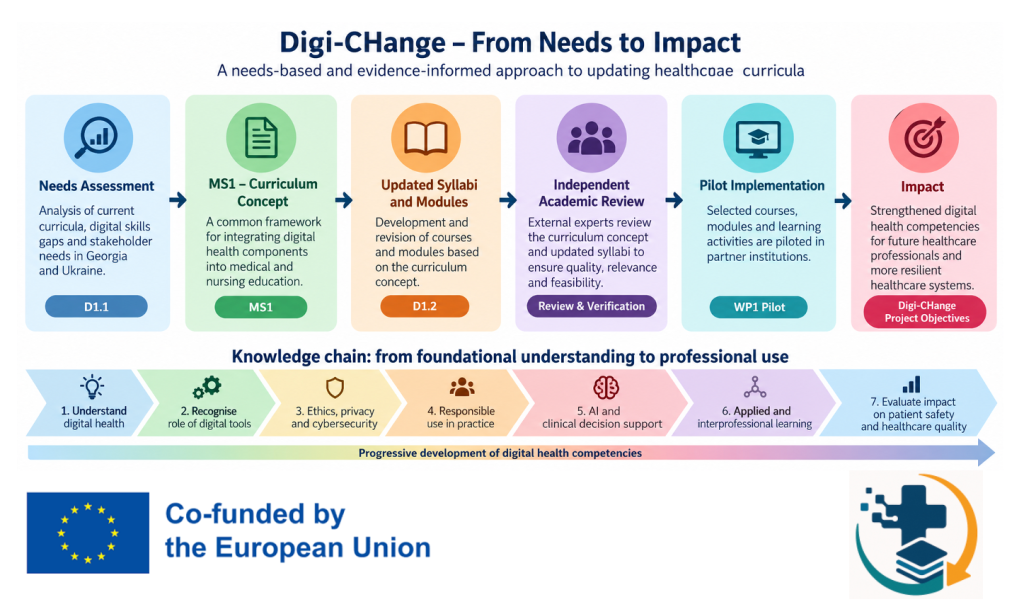
During the days 6-9 of October will take place the Digi-Change conference in Turin, Piedmont region, Italy.
Digi-CHange promotes the digital transformation of medical and nursing education, introducing an inter-professional model that connects educators, clinicians, engineers, and industry innovators. Aligned with the Erasmus+ Capacity Building in Higher Education priority of Digital Transformation, Digi-Change strengthens the capacity of universities in Georgia, Ukraine, and EU partner countries to modernize curricula and foster digital competencies for a sustainable, innovation-ready healthcare workforce.
In the first session, Luis Falcón will deliver a keynote presentation about the social impact of GNU Health and Libre/Free Software is having in the public healthcare system, and how it can be used in the context of Telemedicine to provide meaningful and timely healthcare access to remote areas in Europe. Other topics will be building large federated health networks, privacy, and the human factor in healthcare, medical genetics and precision medicine. Dr. Falcon will address the risks of some emerging technology (eg, LLM) poses at different levels (individual, clinical practice, cultural & scientific community and the environment), and ethical alternatives in eHealth and decision support (DSS)
During this three-day “train-the-trainers” conference, physicians, nurses and other health professionals from Ukraine, Georgia and Latvia will join colleagues from Italy, France, Austria and other European countries to exchange knowledge and experiences.
In the topic of Telemedicine, Alberto Lazzero will address National records and cross-border cooperation among France and Italy. Prof. Dr. Alberto Lazzero is the Head of Telemedicine, Hospital of Briançon (France). He is an specialist in telemedicine for patients in mountain and cross‑border areas.
The conference will be in Turin, onsite, and will count with experts on diagnostic imaging, cancer and bioinformatics, among others. There will be visits to the Istituto Neurologico “Carlo Besta” (Milan) and INOC (National Oncologic Institute Candiolo).
Looking forward to meet our colleagues from Europe in Italy and share the experiences and impact of Free/Libre software in healthcare and our society
We are very happy to announce that the upcoming version of GNU Health Hospital Information System has entered feature-complete alpha stage. This upcoming version of GNU Health HIS 5.0 supposes over a year of work and is the largest release in terms of functionality and refactoring.
GNU Health HIS 5.0 is expected to be released by the end of June.
This new release comes after over a year of development to deliver state-of-the-art libre technology and user experience. In a nutshell:
Tryton 7.0 LTS support
New functionality for patient procedures and medical interventions
Improved reporting and analytics
Enhanced the Laboratory Information System (GNU LIMS – Occhiolino)
New features on patient obstetric history and pregnancy related evaluations
Improved ergonomics and views on demographics and patient related information.
Improved medical genetics and family history taking. Update to the latest genes, proteins and natural variants datasets from UniProt and HUGO
Enhanced socoeconomic and family functionalty assessment
Extensively revised Medical Imaging, DICOM worklists and Orthanc packages
Reorganize nursing and ambulatory care packages
Enhanced patient body composition and anthropometrics
Enhanced “Focus on” patient section, including automated settings and mental health
New insurance and billing features for medical interventions and insurance plans.
Improved patient safety and allergic conditions checks and prescription writing
On the technical side we have worked on:
Migration to Python Poetry and pyproject.toml from setuptools
Increased modularity and minimize dependencies among packages
Simplified installation and administration (Virtual machine images, pip, ansible)
Improved stability using virtual environment in the installation
Over 30 localization and language teams at Codeberg.
At this point, our focus in on testing, translation, packaging and documentation. In the coming days we’ll migrate our community server so we can all test the upcoming version.
For those of you on GNU Health 4.4, please start thinking on the migration project to GH HIS 5.0. This new version is a major leap that delivers many benefits, so we highly encourage you to upgrade. As always, the migration methods and tools are included.
We’d like to invite you to translate GNU Health at Codeberg weblate translation instance and to report any issues you may find during this period.
GNU Health is a Libre, community driven project from GNU Solidario, a non-profit humanitarian organization focused on Social Medicine. Our project has been adopted by public and private health institutions and laboratories, multilateral organizations and national public health systems around the world.
The GNU Health project provides the tools for individuals, health professionals, institutions and governments to proactively assess and improve the underlying determinants of health, from the socioeconomic agents to the molecular basis of disease. From primary health care to precision medicine.
The following are the main components that make up the GNU Health ecosystem:
Hospital Management (HMIS)
Social Medicine and Public Health
Laboratory Management (Occhiolino)
Personal Health Record (MyGNUHealth)
Bioinformatics and Medical Genetics
Thalamus and Federated health networks
GNU Health embedded on Single Board devices
GNU Health is a GNU (www.gnu.org) official package, awarded with the Free Software Foundation award of Social benefit. GNU Health has been declared a Digital Public Good ,adopted by many hospitals, governments and multilateral organizations around the globe.
Fundación Jérôme Lejeune Argentina adopts GNU Health for the research and management of Trisomy 21 and other intellectual disabilities of genetic origin.
We start 2023 with exciting news for the medical and scientific community!
GNU Health has been adopted by Fundación Jérôme Lejeune, a leading organization in the research and management of trisomy 21 (Down Syndrome) and other intellectual disabilities of genetic origin.
Jérôme Lejeune foundation has its headquarters in France, with offices in Argentina, the United States and Spain.
On December 2022, the faculty of engineering from the University of Entre Rios, represented by the dean Diego Campana and the head of the school of Public Health, Fernando Sassetti, formalized the agreement with the director of the Jêrome Lejeune foundation in Argentina, Luz Morano.
The same month, I met in Madrid with the medical director and IT team of Fundación Jérôme Lejeune Spain.
Luz Morano declared “[GNU Health] goes beyond the Foundation, providing the health professionals the specific features to manage a patient with trisomy 21. We are putting a project in the hands of humanity“
[GNU Health] goes beyond the Foundation, providing the health professionals the specific features to manage a patient with trisomy 21. We are putting a project in the hands of humanity
Luz Morano, director of Fundación Jérome Lejeune, Argentina
Morano also stated: “GNU Health will pave the road for the medical management, and let us focus on our two other missions: Research and the defense of patient rights“
GNU Health counts with specific modules for genomics and bioinformatics
The agreement is in the context of the GNU Health Alliance of Academic and Research Institutions that UNER has with GNU Solidario. In this sense, Fernando Sassetti explained “It provides tools for an integrative approach of those people with certain pathologies that due to the reduced number are not managed in the best way. This will benefit the organizations and health professionals, that today lack the means to do so in the best way and timely manner. It benefits the patients, in their right to have an integral health record.”
Research and Open Science
The adoption of GNUHealth by the Jérôme Lejeune Foundation opens new exciting avenues for the scientific community. In addition to the clinical management and medical history, GNU Health will enable scientists to dive into the fields of genomics, epigenetics and exposomics, gathering and processing information from multiple contexts and subjects, thanks to the distributed nature of the GNU Health Federation.
The GNU Health HMIS counts many packages and features, some of them of special interest for this project. In addition to the specific customizations for the foundation, the packages already present in GNUHealth, such as obstetrics, pediatrics, genomics, socioeconomics or lifestyle will provide a holistic approach to the person with trisomy 21 and other related conditions.
All of this will be done using exclusively Free/Libre software and open science.
People before Patients
Trisomy 21 poses challenges for the individual, their family, health professionals and the society. The scientific community needs to push the research to shed light on the etiology, physiopathology and associated clinical manifestations, such as heart defects, blood disorders or Alzheimer’s.
Most importantly, as part of the scientific community, we must put a stop to the discrimination and stigmatization. We must tear down the barriers and walls built on our societies that prevent the inclusion of individuals with trisomy 21.
As part of this effort, GNU Health provides the WHO International Classification on Functioning, disability and health (ICF). In other words, is not just the health condition or disorder we may have, but how the environmental factors and barriers influence the normal functioning and integration as individuals in the society. Many times, those physical, artificial barriers present in our daily lives are way more pernicious than the condition itself.
The strong focus of GNU Health in Social Medicine, and the way we perceive medicine as a social science will help improving the life of the person living with trisomy 21, and contribute to the much needed healing process in our societies. We need to work on the molecular basis of the health conditions, but little can be done if without empathetic, inclusive and supportive societies so people can live and enjoy life with dignity, no matter their health or socioeconomic status.
Projects like this represent the spirit of GNU Health and make me immensely proud to be part of this community.
Happy and healthy hacking! Luis Falcon, MD President, GNU Solidario
GNU Solidario and Leibniz Universität Hannover (LUH) are now partners in GNU Health, the Libre digital health ecosystem.
This agreement makes the German university a member of the GNU Health Alliance of academic and research institutions, to work on the research and development of GNU Health, the award-winning Libre digital health ecosystem.
The partnership was signed on February 2nd, 2022, by Prof. Dr.-Ing. Gabriele von Voigt, head of the Computational Health Informatics department at Leibniz Universität Hannover and Dr. Luis Falcón, president of GNU Solidario.
University of Hanover main building. Source: LUH
We are excited and looking forward to cooperate and research in areas such as privacy, distributed health networks, bioinformatics, hospital management or Personal Health Records. Leibniz Universität Hannover has been using the GNU Health Hospital Management System component for quite sometime now internally, in their health informatics department. This agreement will boost even more the adoption of the libre health ecosystem.
Some of the components from the GNU Health digital health ecosystem
Leibniz Universität Hannover is a reference for the adoption of GNU Health in European universities, serving as a model of open science and free/libre software in public academic institutions. Moreover, being part of the GNU Health Alliance of Academic and Research Institutions opens up horizons to collaborate with other universities around the world.
We are positive that this agreement will help promoting the adoption of GNU Health and Libre Software within the healthcare system and biomedical research in Europe.
The logo of Leibniz University is a visual Leibniz quote. It shows the binary number system as first outlined by Gottfried Wilhelm Leibniz in his New Year’s letter of January 1697 to Duke Rudolf August of Wolfenbüttel.
About Leibniz Universität Hannover:
The Leibniz University Hannover, long form in German Gottfried Wilhelm Leibniz Universität Hannover, is a public research university located in Hanover, Germany. Founded on 2 May 1831, it is one of the largest and oldest science and technology universities in Germany. It has nine faculties which offer 190 full and part degree programs in 38 fields of study.It was named University of Hannover in 1978. In 2006, it was named after Gottfried Wilhelm Leibniz, the 18th century mathematician and philosopher. In 2018, Leibniz University Hannover was adopted as the official English name.
Leibniz University Hannover is a member of TU9, an association of the nine leading Institutes of Technology in Germany. It is also a member of the Conference of European Schools for Advanced Engineering Education and Research (CESAER), a non-profit association of leading engineering universities in Europe. The university sponsors the German National Library of Science and Technology (TIB), the largest science and technology library in the world
The GNU Health Alliance of Academic and Research Institutions is a GNU Solidario program comprising a global network of academic and research institutions around the world with the mission of provide a sustainable solutions to the current social and biomedical challenges, using GNU Health and Free Software components.